Tell us about the job
Takes about a minute. No obligation.
Sizing a heat pump for Grafton County is not a catalog exercise. Homes in Grafton County, NH run heat about nine months a year, from September through May. As outdoor temperatures drop toward and below freezing, a heat pump's capacity falls, and a unit that looks adequate on paper can fall short on the coldest nights. A contractor calculating the right system has to establish where that capacity floor lands for this location and what backup heat covers the gap. Get that balance wrong at installation and the resistance strips carry a load they were never meant to carry as a primary heat source.
Ductwork laid out for a furnace was sized around a different airflow pattern than a heat pump runs on, and in Grafton County a large share of the housing predates the equipment now in it. Half the homes in Grafton County, New Hampshire were built in 1981 or earlier (2020-2024 ACS 5-year). When a contractor prices a heat pump install here, the duct system draws the first real scrutiny: whether the existing runs will carry the volume the new equipment moves, and whether the electrical service has the capacity the unit needs. Those two questions, answered by what is physically in the house, are where the job's scope gets set.
What Gets Installed With a New Heat Pump
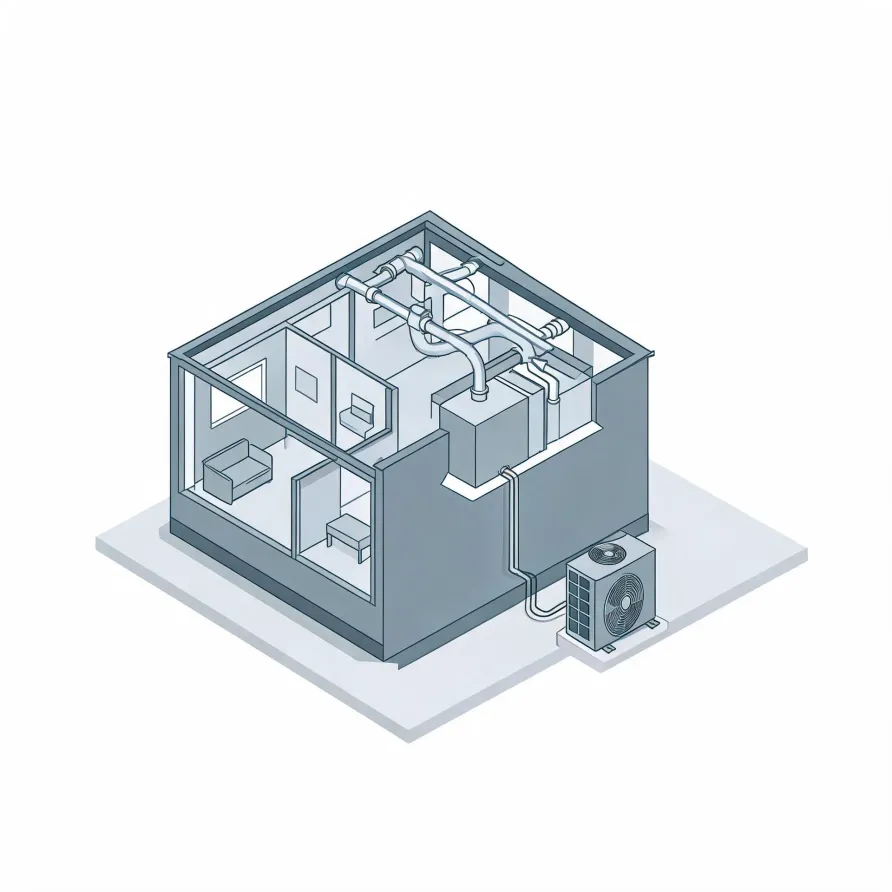
The outdoor unit sits on a pad beside the house and holds the compressor and the coil that exchange heat with the outside air. Inside, the air handler mounts in a utility space, a closet, or an attic and pushes conditioned air through the home. These two units are the heart of what a contractor brings to the job.
A refrigerant line set runs between the outdoor unit and the air handler, carrying refrigerant back and forth through insulated copper tubing. A thermostat or control panel goes on an interior wall and gives the homeowner a way to set temperatures. A condensate drain line runs from the air handler to carry away moisture the system pulls from the air.
The drawing beside this text shows a typical layout, and a licensed contractor determines exactly how each piece fits the setup in your house.
Get matched in Grafton CountyGrafton County, by the numbers
242 severe weather events were recorded in Grafton County, New Hampshire between 2015 and 2024.
NOAA National Centers for Environmental Information, Storm Events Database, bulk CSV export, events 2015-01-01 through 2024-12-31.Half the homes in Grafton County, New Hampshire were built in 1981 or earlier (2020-2024 ACS 5-year).
U.S. Census Bureau, 2020-2024 American Community Survey 5-Year EstimatesGrafton County, New Hampshire holds 51,920 housing units (2020-2024 ACS 5-year).
U.S. Census Bureau, 2020-2024 American Community Survey 5-Year EstimatesOwners occupy 71.3% of the occupied homes in Grafton County, New Hampshire (2020-2024 ACS 5-year).
U.S. Census Bureau, 2020-2024 American Community Survey 5-Year EstimatesRules and Standards Behind Heat Pump Installation in Grafton County, New Hampshire2 sourced rules and standards
Licensing and Legal Requirements in Grafton County, New Hampshire
New Hampshire's mechanical licensing board issues nine credentials — hearth system, four fuel gas endorsements, domestic appliance technician, and master, journeyman and apprentice plumber — and a licensee may not work outside the specialty their licence names. None of the nine is an HVAC licence.
New Hampshire does not license HVAC as a trade, and says so where it matters: the plumbing licence expressly does not reach a person installing heating, cooling, air conditioning or domestic water heating systems, whether solar, oil, gas or electric. The gas piping on a gas-fired system is a separate matter and needs a fuel gas fitter licence.
Severe Weather Events in Grafton County
Grafton County winters put real demands on heating equipment, and summer cooling loads follow their own pattern. What a heat pump faces here is a local question, and the weather record is part of the answer.
242 severe weather events, 2015–2024. Source: NOAA National Centers for Environmental Information, Storm Events Database.