Tell us about the job
Takes about a minute. No obligation.
Sizing a heat pump for Coos County starts with understanding what the coldest months actually demand, because capacity falls as outdoor temperatures fall and a unit that looks adequate on paper can run at its limit through the worst weeks. Homes in Coos County, NH run heat about ten months a year, from September through June. The compressor cycles through the full run of heating season cold, not just brief cold snaps, and that sustained load is what a contractor has to account for in both the equipment selection and the backup heat spec. An undersized unit does not fail quietly here; it shows in short-cycling, reduced output, and early wear on the refrigerant circuit.
Ductwork laid out for an oil furnace or electric baseboard system was built around a different airflow pattern entirely. Half the homes in Coos County, New Hampshire were built in 1969 or earlier (2020-2024 ACS 5-year). What that means for a heat pump installation is that the existing runs, the registers, and the returns may all need to be assessed before the equipment itself can be priced. A contractor working in this county opens walls or accesses crawl spaces to find out whether the supply side can carry what a heat pump actually moves, and frequently it cannot without changes to the layout or the register sizing.
What Gets Installed With a New Heat Pump
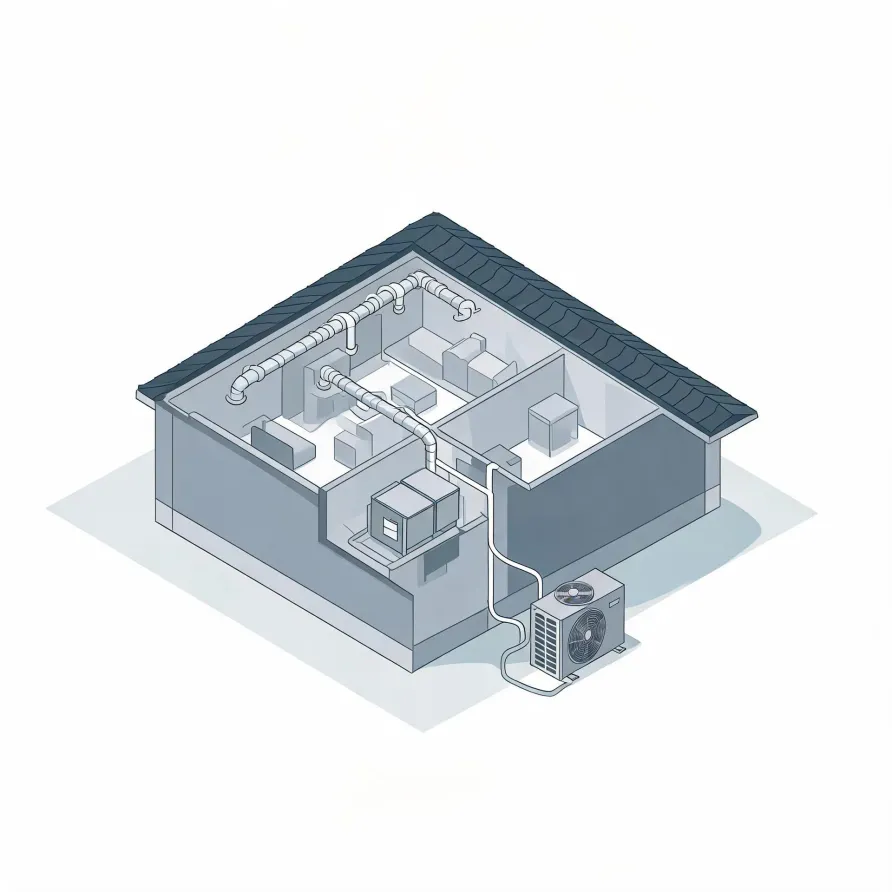
The outdoor unit sits on a pad beside the house and holds the compressor and the coil that exchange heat with outside air. Inside, the air handler mounts in a utility space, a closet, or a basement and moves conditioned air through the home. These two units are the core of what a contractor brings in and sets in place.
A refrigerant line set runs between the outdoor unit and the air handler, carrying refrigerant between the two. A thermostat goes on an interior wall where it reads the temperature of the living space and tells the system when to run. Some installations also include a secondary electric resistance element inside the air handler to handle the coldest stretches of the heating season.
The drawing shows how these pieces relate in a typical layout, and a licensed contractor determines exactly what the configuration looks like for this house.
Get matched in Coos CountyCoos County by the Numbers
184 severe weather events were recorded in Coos County, New Hampshire between 2015 and 2024.
NOAA National Centers for Environmental Information, Storm Events Database, bulk CSV export, events 2015-01-01 through 2024-12-31.Half the homes in Coos County, New Hampshire were built in 1969 or earlier (2020-2024 ACS 5-year).
U.S. Census Bureau, 2020-2024 American Community Survey 5-Year EstimatesCoos County, New Hampshire holds 20,637 housing units (2020-2024 ACS 5-year).
U.S. Census Bureau, 2020-2024 American Community Survey 5-Year EstimatesOwners occupy 74.2% of the occupied homes in Coos County, New Hampshire (2020-2024 ACS 5-year).
U.S. Census Bureau, 2020-2024 American Community Survey 5-Year EstimatesInstallation Rules & Codes for Heat Pumps in Coos County, New Hampshire2 sourced rules and standards
Licensing Rules for HVAC Work in Coos County, New Hampshire
New Hampshire's mechanical licensing board issues nine credentials — hearth system, four fuel gas endorsements, domestic appliance technician, and master, journeyman and apprentice plumber — and a licensee may not work outside the specialty their licence names. None of the nine is an HVAC licence.
New Hampshire does not license HVAC as a trade, and says so where it matters: the plumbing licence expressly does not reach a person installing heating, cooling, air conditioning or domestic water heating systems, whether solar, oil, gas or electric. The gas piping on a gas-fired system is a separate matter and needs a fuel gas fitter licence.
Severe Weather Events in Coos County
New Hampshire winters put sustained demand on heating equipment, and the summers ask nearly as much of cooling systems. How hard the weather pushes in Coos County shapes what a heat pump here has to handle, which is why local conditions belong in any honest conversation about installation.
184 severe weather events, 2015–2024. Source: NOAA National Centers for Environmental Information, Storm Events Database.