Tell us about the job
Takes about a minute. No obligation.
Sizing a heat pump for this county is not a catalog exercise. A contractor has to establish what the system can actually deliver at the coldest outdoor temperatures before they can settle on a unit and a backup heat strategy. Homes in Rockingham County, NH run heat about eight months a year, from October through May. Through that stretch, a heat pump's refrigerant cycle loses capacity as temperatures drop, so a unit that tests fine in moderate weather hands the load to its resistance strips on the hardest days. An installer who skips a proper load calculation leaves a homeowner with either a backup system that runs constantly or one that cannot keep up. The refrigerant circuit, the coil, and the compressor all earn their wear through those months, and the quality of the original installation determines how evenly that load is distributed across them.
Ductwork laid out for a furnace and central AC handles air differently than a heat pump needs it to. Half the homes in Rockingham County, New Hampshire were built in 1983 or earlier (2020-2024 ACS 5-year). That means a contractor sizing a heat pump here is working through what the existing duct runs will and will not carry, not just selecting a unit. Where the distribution system falls short, the installation scope grows to match it. The electrical service gets the same scrutiny, because a heat pump's draw has to fit what the panel was built to supply.
What a Heat Pump Installation Covers
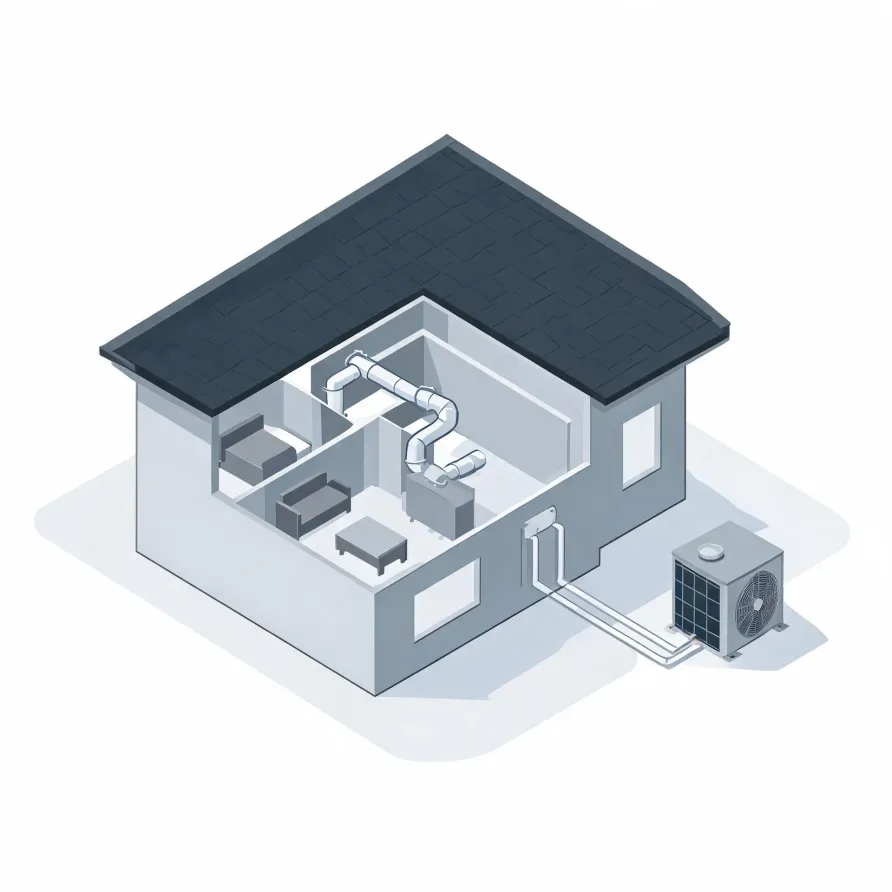
The outdoor unit sits on a pad beside the house and holds the compressor and the coil that exchange heat with the outside air. Inside, an air handler mounts in a mechanical room, closet, or attic and moves conditioned air through the home. These two units are the core of what a contractor puts in place.
A refrigerant line set runs between the outdoor unit and the air handler, connecting the two and carrying the refrigerant that makes the system work. A thermostat goes on an interior wall where it reads the temperature of the living space and signals the system to run.
The drawing beside this text shows a typical layout, and a licensed contractor determines exactly what applies to your house.
Get matched in Rockingham CountyRockingham County, by the numbers
200 severe weather events were recorded in Rockingham County, New Hampshire between 2015 and 2024.
NOAA National Centers for Environmental Information, Storm Events Database, bulk CSV export, events 2015-01-01 through 2024-12-31.Half the homes in Rockingham County, New Hampshire were built in 1983 or earlier (2020-2024 ACS 5-year).
U.S. Census Bureau, 2020-2024 American Community Survey 5-Year EstimatesRockingham County, New Hampshire holds 137,794 housing units (2020-2024 ACS 5-year).
U.S. Census Bureau, 2020-2024 American Community Survey 5-Year EstimatesOwners occupy 78.4% of the occupied homes in Rockingham County, New Hampshire (2020-2024 ACS 5-year).
U.S. Census Bureau, 2020-2024 American Community Survey 5-Year EstimatesRules and Standards Behind Heat Pump Installation in Rockingham County, New Hampshire2 sourced rules and standards
Licensing Rules for HVAC Work in Rockingham County, New Hampshire
New Hampshire's mechanical licensing board issues nine credentials — hearth system, four fuel gas endorsements, domestic appliance technician, and master, journeyman and apprentice plumber — and a licensee may not work outside the specialty their licence names. None of the nine is an HVAC licence.
New Hampshire does not license HVAC as a trade, and says so where it matters: the plumbing licence expressly does not reach a person installing heating, cooling, air conditioning or domestic water heating systems, whether solar, oil, gas or electric. The gas piping on a gas-fired system is a separate matter and needs a fuel gas fitter licence.
Severe Weather Events in Rockingham County
Rockingham County weather puts real demands on heating and cooling equipment, and those demands shape what a heat pump here needs to handle. How hard a system works, and how long it lasts, is a local question.
200 severe weather events, 2015–2024. Source: NOAA National Centers for Environmental Information, Storm Events Database.