What defrost mode means on a New Hampshire heat pump

Send the request today and stop worrying about who to call.

Hand it off

Why does my heat pump blow cold air and then steam?

You walked by the outdoor unit and saw steam coming off it, or felt a cold draft inside right after the heat pump kicked on. With oil prices what they are, you're running the heat pump to save money on the coldest days, and anything that looks wrong makes you want to shut it off before it costs you more. It's not broken.

It's defrosting the outdoor coil

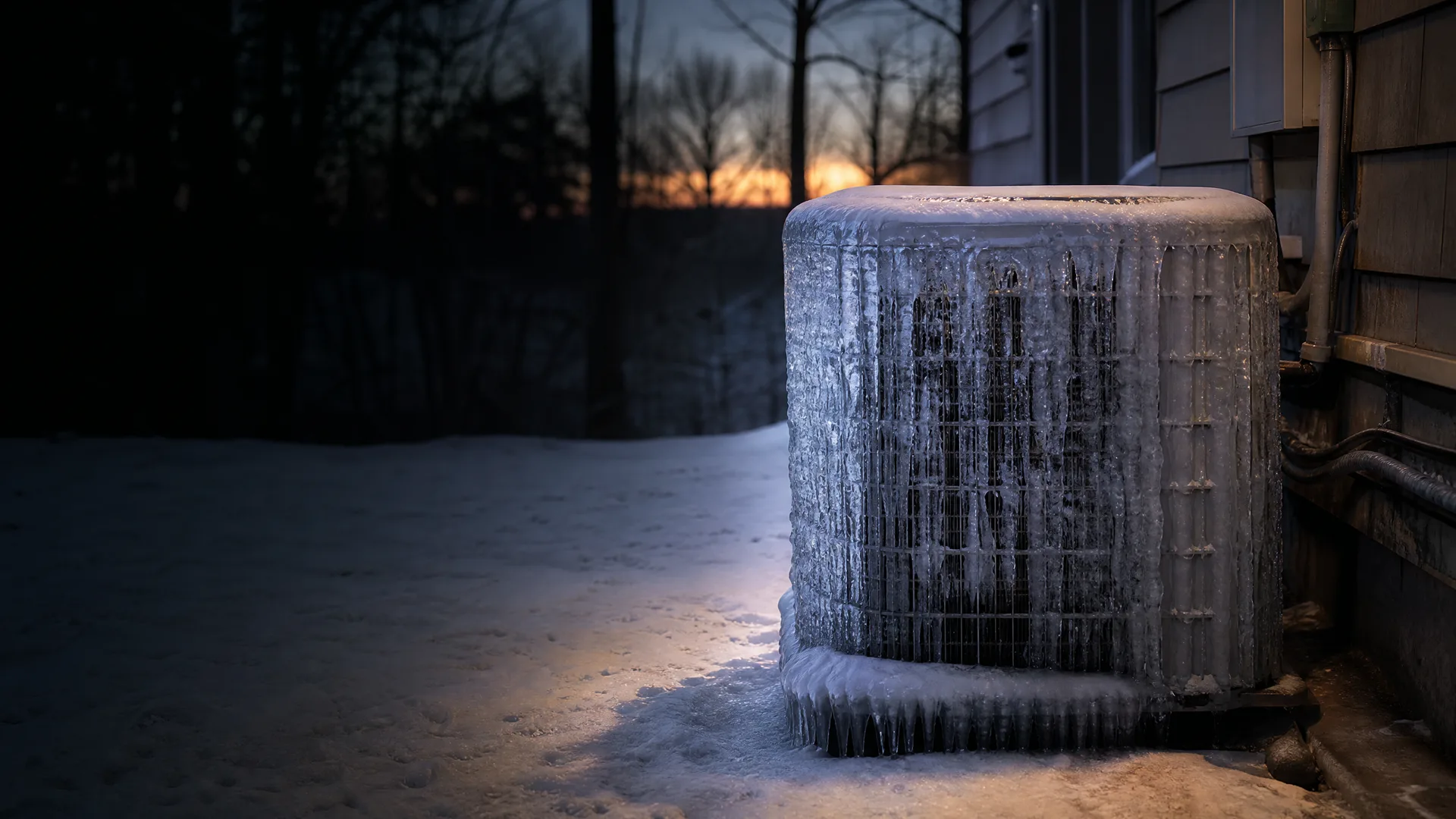
The steam is melting frost leaving the outdoor unit, and the cold air inside is the system running backward for a few minutes to do it. In cold, damp weather, frost builds up on the outdoor coil the same way it builds on a freezer wall. The heat pump has to clear that frost off or it can't pull heat from the outside air at all. To do it, it reverses itself and sends heat outside instead of in, which is why the air coming through your vents turns cold for a few minutes. It should run for ten minutes or less, then switch back and the warm air returns. If it's running cold for longer than that, or doing it every hour instead of a few times a day, something is keeping it from finishing the cycle.

An outdoor condenser unit encased in thick ice stands on snow beside a house with horizontal siding and exterior pipes, with bare trees and a sunset glow in the background.

You're out before the sun's up, boots crunching on the frozen grass, heading to the car. The outdoor unit sits there in the half dark, coated in ice, thick on the coils, a crust of it over the fan grille. Your breath hangs in the air. The house behind you is quiet, everyone still asleep, still warm. You stop and look at it a second, this block of ice where a machine should be. No steam this time, no hum. Just ice, and a January morning that isn't done getting colder, and a house that's going to need that heat before anyone else gets up.


Is this normal, or is something wrong with my heat pump

You hear the outdoor unit switch on and off more than usual, and a few minutes later it sounds like a furnace fan running outside. Inside, you might catch a short burst of cool air coming from the vents before the warm air comes back. If you check the unit again after a half hour, the ice should be gone. If it's not, or the unit cycles into defrost every ten or fifteen minutes instead of settling down, that's not New Hampshire cold doing its normal thing. It usually means a sensor or valve isn't telling the system what it needs to know, and the unit is stuck running more cycles than it should. Left alone, that's more power drawn for less heat, which matters here with what electricity costs.

A woman in a knitted shawl sits in a living room with a fireplace, shelves, a sofa with cushions, and a lamp by a bright window, looking off to the side.
A woman with long brown wavy hair in a green shirt over a white top stands in a living room with built-in white shelves, a ceiling fan, a potted plant and a sliding glass door.
A woman with shoulder-length gray-streaked hair in a light gray knit sweater stands smiling and looking off to the side in a living room with a sofa, houseplant, framed picture, and sunlit sliding glass door.
A woman with shoulder-length curly gray hair wearing a gray knit sweater stands near a window with a sheer curtain, looking to the side, with a blurred interior room behind her.

Hand off the heat pump problem

A heat pump that won't come out of defrost, or that goes into it every half hour instead of once in a while, is telling you something failed. It might be the defrost control board, a frozen sensor giving it bad readings, or a reversing valve stuck in the wrong position. None of those clear up on their own, and running an oil furnace as backup while it sits broken costs you on top of what you're already paying for electricity here. A tech who works on heat pumps all winter in New Hampshire has seen this exact fault before, probably this week, and knows which part on your system tends to go first. That's different from guessing over the phone. Send the request through and it goes to one local contractor who handles this equipment, not a handful of companies competing for your callback. You stop tracking down who's available and who knows what they're looking at. The unit outside keeps icing and thawing until someone who knows the fix gets to it.

A gray outdoor air conditioner condenser unit on a concrete pad beside a house with horizontal lap siding and a stone veneer base, with a conduit running to a wall-mounted disconnect box and shrubs and evergreen trees to the left.

Defrosting the way it should

A thin coat of frost on the coil, gone within ten minutes, the fan back to its normal sound after. The unit cycles into defrost a few times on a cold day and comes right back out. No ice on the cabinet, no puddle freezing under it.

An outdoor air conditioning condenser unit sits on a concrete pad beside a white horizontal-siding house, with a gray electrical disconnect box and insulated refrigerant lines on the wall, mulch and green shrubs to the right, and a concrete slab in the foreground.

Defrosting the way it shouldn't

Ice building up faster than the cycle clears it, climbing the coil and spreading onto the fan grille. The unit stays in defrost longer each time, or drops into it every half hour. That pattern on a unit this age usually means a part is failing underneath it.

A dirty outdoor air conditioner condenser unit with debris on its coil grille, sitting on a concrete pad beside a light-colored horizontal siding wall, with bare dirt ground in front and a shrub at right.
Before you get your heat pump repair
A gray outdoor condenser unit on a concrete pad beside a house with horizontal lap siding, with a metal disconnect box and refrigerant lines on the wall, river rock and mulch to the sides, and a green shrub at right.
After you get your heat pump repair
A gray outdoor condenser unit on a concrete pad beside a house with gray lap siding, connected by conduit and refrigerant lines to a wall-mounted disconnect box, with a green shrub and mulch bed at left.

Running clean

The unit cycles through defrost and gets back to work. The pad under it is clear, the conduit and disconnect box are dry, and there's no frost creeping up the cabinet sides. You hear it switch off, run a few minutes, and switch back to heating without you noticing much.

An outdoor air conditioning or heat pump condenser unit on a concrete pad beside a house with horizontal vinyl siding, a gray electrical disconnect box and conduit on the wall, and a concrete walkway in the foreground.

Losing the fight

Dirt and grime cake the cabinet, and frost builds faster than defrost mode can clear it. The unit next to a wall like this is working harder each cycle just to keep up. Left alone, the coil ices over for good and the heat pump stops putting out warm air at all.

Power costs 24.53 cents per kilowatt-hour statewide

At 24.53 cents a kilowatt-hour, a heat pump stuck in defrost too often isn't just annoying, it's running extra power to fight ice instead of heating your house. Get that fixed and you're paying for heat, not for melting frost.

EIA-861 2025 statewide residential average

A woman and a child wrapped together in a thick knitted blanket on a sofa, both with eyes closed, with a lit table lamp and houseplant in the dim background.
An older woman with gray hair in a bun and glasses, wearing a beige knit sweater, smiles while looking to the side in a warmly lit kitchen, with a loaf of bread on the counter in the foreground and a snowy scene outside the window.

Defrost mode is the outdoor unit melting ice off its coil so it can keep pulling heat from the cold air outside. A few minutes every so often is the unit doing its job. Long stretches of it, or ice that keeps building back on the cabinet, mean a part has failed and the heat pump is fighting itself instead of heating your house. In New Hampshire, with oil as the alternative and power priced the way it is here, that's not a system you want to leave guessing through a cold snap. The contractor who takes this job is local, licensed, and works on heat pumps all winter, so they've already seen what a defrost board, a frozen sensor, or a stuck reversing valve looks like on a unit like yours. You'll hear from one contractor, not a handful of companies competing for your callback. Send the request and the search for who to call is off your plate.

A single-story stucco house at dusk with a lit paver walkway lined by low path lights, desert plants and boulders in front, and distant mountains under an orange and blue sky.

Heat Pump Repair

Send one request and you're done looking

Step 1 of 3: Equipment
  • A cream chunky cable-knit throw draped over a beige upholstered armchair beside a bright window, with a wooden side table holding a book and a vase of leafy branches at left.
    • Tell a local repair pro what your heat pump is doing.
    • Describe your heat pump job, and a local pro who handles it gets in touch.
  • Living room corner with a gray sofa holding beige pillows and a knit throw, a round wooden coffee table with a dark planter and shallow bowl, a jute rug, a floor lamp, a framed landscape print on the wall, and a window showing trees.
    • One request and the search for a pro is handled.
    • Send it once and finding someone is no longer on you.
  • A living room corner with a cream sofa and cushion, knit throw, wooden coffee table holding a shallow bowl and dark ceramic vase with green foliage, a floor lamp, potted plant in a woven basket, and linen curtains at a window.
    • Answer a few questions instead of calling shop after shop.
    • Describe your heat pump job once, to one pro.
  • A round reclaimed-wood coffee table with a black metal base sits on a woven rug in front of a cream sofa with cushions, with a lit built-in fireplace and a tall indoor tree in the background.
    • Your request stays with one local pro.
    • Your request goes to one pro, not a list of companies.